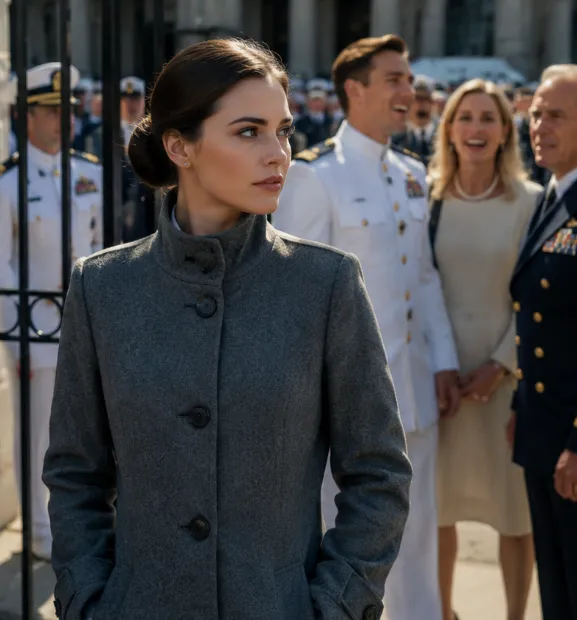
I stood outside the ceremonial gate at Naval Station Norfolk with the wind pressing my gray wool coat against my legs and the Atlantic shining like hammered silver beyond the piers. Inside the black iron fence, white uniforms gleamed beneath the Virginia sun. Brass instruments warmed up in trembling notes. Families clutched coffee cups, programs, flowers, pride.
My brother’s pride had always required an audience.
Commander Marcus Cartwright stood near the platform in dress whites, laughing as if the world had gathered exactly where it belonged—around him. My mother, Vivian, floated beside him in cream silk and pearls. My father, retired Captain Robert Cartwright, wore his old Navy uniform, every medal arranged with punishing precision.
I gave the young ensign my name.
“Leah Cartwright.”
He checked the tablet. Then checked again. His face tightened.
“I’m sorry, ma’am. You’re not on Commander Cartwright’s guest list.”
The words struck with a familiar dullness. Not surprise. Recognition.
Behind him, Marcus looked over.
For half a second, my brother’s smile faltered.
Then he leaned toward his wife and said loudly, “Leah forgot to RSVP. Some people never learn the chain of command.”
A few people laughed.
My mother looked away.
My father adjusted his cuffs.
And in that moment, I understood that they had not forgotten me. They had removed me.
The ensign swallowed. “Without authorization, I can’t let you through.”
“I understand,” I said.
My voice sounded calm. It had taken the Navy twenty-two years to teach me that kind of calm. Or maybe my family had started the training long before.
Marcus had always been the golden child. When he joined ROTC, my father raised a glass and said, “The Cartwright legacy continues.” When I won a national science prize at twelve for mapping underwater acoustic distortion, my mother whispered, “Don’t leave the certificate on the dining table.”
Marcus became the son they displayed.
I became the daughter they explained away.
At Annapolis, Marcus learned to command rooms.
I learned to survive them.
He chose promotion tracks, photographs, speeches.
I chose intelligence, languages, classified waters, rooms without windows, and missions that disappeared from public records.
At family dinners, Marcus spoke for forty minutes about leadership.
When anyone asked about my work, I said, “It’s busy.”
No one asked more.
I let them believe I was ordinary because the Navy required silence. But I also let them believe it because, after a while, begging to be seen became more humiliating than being invisible.
I turned to leave.
Then a black government SUV rolled to the curb.
The conversations around the gate faded.
The rear window lowered.
A calm male voice said, “Stand down, Ensign.”
The ensign stiffened. “Sir?”
“She’s not on your list because her clearance outranks yours.”
The SUV door opened.
Admiral Henry Shaw stepped out in full dress uniform.
May you like

The entire checkpoint seemed to inhale.
Shaw did not look at Marcus. He did not look at my parents. He walked directly to me, stopped before me, and extended his hand.
“Admiral Cartwright.”
The ensign’s tablet slipped from his hand and cracked against the pavement.
Silence fell so suddenly even the brass band died mid-note.
Marcus blinked. “That’s impossible.”
Admiral Shaw turned his head.
“Commander Cartwright, I suggest you choose your next sentence carefully.”
Marcus closed his mouth.
For the first time in my life, my brother looked at me and did not know where to place me.
Shaw gestured toward the gate. “Shall we?”
But I did not move.
Because this was no longer about entering a ceremony.
This was about every locked door my family had built inside their minds—and the fact that I had arrived with the key.
Slowly, I lifted my hand to my coat.
One button opened.
Then another.
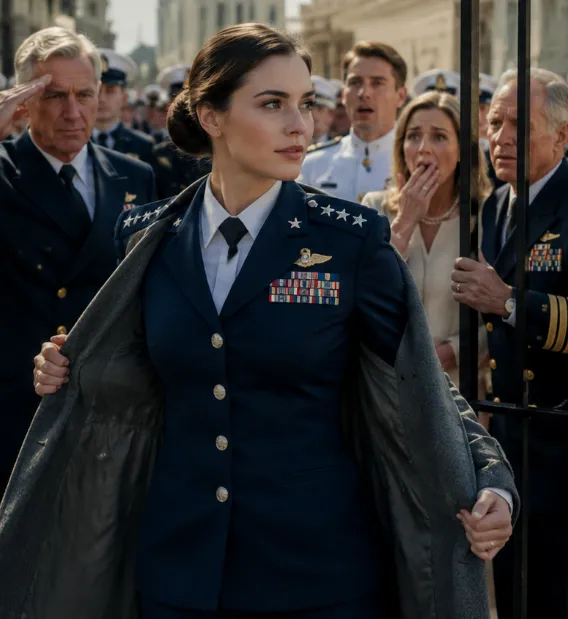
The dark Navy dress uniform appeared beneath the wool. Ribbons. Medals. The polished weight of a life no one in my family had bothered to imagine.
Then the four stars on my shoulders caught the sun.
My mother whispered, “Leah…”
My father gripped the iron fence.
Marcus went pale.
Admiral Shaw turned toward the ceremony platform.
“There has been a correction to today’s program.”
An officer hurried forward carrying a sealed blue folder. Shaw accepted it and raised it.
“Before Commander Marcus Cartwright’s promotion proceeds,” he announced, “the Navy will formally recognize the officer whose classified service made this command possible.”
His eyes moved to my family.
“And whose own family failed to list her as a guest.”
A murmur spread through the crowd.
My father stepped forward. “Admiral Shaw, there must be some misunderstanding.”
“There was,” Shaw replied. “For twenty-two years.”
The words landed like a verdict.
My mother’s lips trembled. Marcus stared at my uniform as if it were an accusation stitched in blue fabric.
I stepped through the gate.
No one stopped me.
Every officer I passed snapped to attention. The sound moved through the crowd like wind through steel. Boots shifted. Spines straightened. Hands rose in salute.
My father did not salute.
Not at first.
He stood frozen, trapped between the rank on my shoulders and the daughter he had spent a lifetime dismissing.
Then, slowly, painfully, his hand came up.
A salute.
Not from a father.
From a captain.
And somehow that hurt worse.
The ceremony platform waited ahead. Marcus’s promotion banner fluttered behind it, his name printed in gold letters.
COMMANDER MARCUS CARTWRIGHT
PROMOTION CEREMONY
I saw him look at it, then at me.
He knew.
Something was wrong.
Admiral Shaw opened the blue folder. “Admiral Leah Cartwright’s service record remains largely classified. What can be said today is this: her operational leadership prevented the compromise of Atlantic fleet movements, exposed a foreign surveillance network, and saved the lives of sailors whose families are standing among us now.”
Gasps rippled through the rows.
My mother covered her mouth.
I kept my eyes forward.
Shaw continued. “Today’s promotion ceremony was approved under standard review. However, new evidence surfaced this morning regarding security irregularities tied to Commander Marcus Cartwright’s last command cycle.”
Marcus stiffened.
My father’s head snapped toward him.
“What evidence?” Marcus demanded.
Shaw’s voice was quiet. “That is not a question you want answered in public.”
Marcus laughed once, brittle and desperate. “This is absurd. Leah shows up in costume and suddenly I’m under investigation?”
The crowd froze.
I heard my mother whisper, “Marcus, stop.”
But Marcus had never been good at stopping when applause was slipping away.
“You all don’t know her,” he said, pointing at me. “She disappears for years, lies to her own family, and now we’re supposed to believe she’s some hero?”
I looked at him then.
Really looked.
And for a moment, beneath the arrogance, I saw fear.
Not confusion.
Fear.
Admiral Shaw closed the folder.
“Commander Cartwright,” he said, “you are relieved of participation in this ceremony pending inquiry.”
The color drained from Marcus’s face.
“No.”
Two officers stepped forward.
My mother made a broken sound. My father turned slowly toward Marcus, and I saw an old man’s world begin to fracture.
“What have you done?” he asked.
Marcus’s mouth opened. Closed.
Then he looked at me with hatred so pure it almost felt childish.
“You did this.”
I said nothing.
Because he was wrong.
And also because he was not entirely wrong.
Three nights earlier, at 2:17 a.m., I had been standing in a secure operations room beneath a facility whose name did not appear on maps. Screens glowed blue across tired faces. A sonar reconstruction played again and again, a ghostly pattern of sound moving beneath the Atlantic.
The ocean speaks in pressure and echo. Most people hear nothing.
I had spent my life listening.
The anomaly was small—a distortion embedded in routine fleet telemetry. Someone had masked unauthorized transmissions inside acoustic maintenance data. Elegant work. Dangerous work.
The kind of betrayal that could get sailors killed without ever firing a shot.
My team traced the leak through seven nodes, three false identities, and one classified access chain.
It ended at Marcus’s command credentials.
At first, I refused to believe it.
Not because Marcus was honorable. I knew better than that.
But because treason required depth, patience, darkness.
Marcus was vain. Cruel. Jealous.
I did not think he was stupid enough to endanger lives.
Then we found the second signature.
A private key older than Marcus’s career.
Registered under a retired captain’s dormant access archive.
Robert Cartwright.
My father.
When Admiral Shaw entered the room that night, I was still staring at the screen.
“Leah,” he said softly.
I could not move.
My family had erased me from dinners, photographs, Christmas cards, conversations.
But this was different.
This was not rejection. This was betrayal wearing my name.
“The promotion ceremony is in three days,” Shaw said. “If we arrest them quietly now, the network may disappear. If we let the ceremony proceed, we can watch who moves.”
“You want to use me as bait.”
“I want to use what they believe about you.”
Invisible.
Unimportant.
Forgotten.
I laughed then, but there was no humor in it.
“At least they gave me something useful.”
Now, standing on the ceremony platform, I felt the trap closing.
Not around Marcus.
Around someone else.
My father stepped toward Shaw. “Admiral, I demand clarification.”
Shaw’s eyes narrowed. “You are in no position to demand anything, Captain Cartwright.”
My father flinched.
The crowd shifted uneasily. Guests who had arrived expecting cake and applause now looked as if the ground beneath the ceremony had opened.
Marcus’s wife, Lauren, stood rigid near the front row. Her face was white, but her eyes were not on Marcus.
They were on my father.
That tiny detail struck me like a match.
Lauren knew something.
Then my mother moved.
She stepped away from Marcus. Away from my father. Toward me.
“Leah,” she whispered, “please tell me this isn’t what it sounds like.”
I wanted to hate her in that moment. It would have been easier.
But she looked small. Frightened. Not the polished woman who had looked away at the gate.
Just my mother.
“I don’t know what you think it sounds like,” I said.
Her eyes filled. “Robert?”
My father barked, “Vivian, don’t.”
It was the tone that changed everything.
Not anger.
Warning.
My mother froze.
I turned to him. “Why shouldn’t she speak?”
My father’s jaw worked.
Marcus stared at him now too.
For the first time all morning, my brother looked less like the favored son and more like another person standing outside a locked room.
Admiral Shaw gave one almost invisible nod.
Two more officers moved into position near the exits.
My father noticed.
So did Lauren.
And then, from somewhere beyond the ceremony grounds, a low horn sounded across the harbor.
One long note.
The scheduled signal for ship movement.
Except no ship was due to depart.
My radio earpiece crackled.
“Admiral Cartwright,” a voice said. “We have movement on the false node.”
My pulse slowed.
There it was.
The network had reacted.
I looked at Shaw.
He already knew.
“Proceed,” I said.
Marcus stared at me. “Proceed with what?”
No one answered.
Across the harbor, sunlight flashed on the water. Somewhere beneath the surface, a hidden relay activated, believing the ceremony chaos had created its opening.
Believing Leah Cartwright was still the family embarrassment at the gate.
Believing wrong.
My team fed the signal exactly what it wanted: a false fleet movement package carrying a silent marker.
The marker returned in thirteen seconds.
To a receiver inside the ceremonial grounds.
My earpiece crackled again.
“Source localized. Front row. Civilian device.”
My eyes moved slowly across the crowd.
Past officers.
Past guests.
Past my mother.
Past Lauren.
Then stopped.
On a woman in a navy-blue dress seated two rows behind my family.
She was in her sixties, silver hair pinned beneath a small hat, hands folded over a program.
I knew her.
Everyone in the Cartwright family knew her.
Eleanor Voss.
My father’s oldest friend.
Marcus’s godmother.
The woman who had come to every birthday, every promotion, every family funeral with lemon cake and lipstick kisses.
Aunt Eleanor.
She looked up at me.
And smiled.
Not warmly.
Proudly.
Like a teacher watching a student finally solve the last equation.
My stomach tightened.
“Admiral?” Shaw asked quietly.
I did not take my eyes off her.
“Detain Eleanor Voss.”
The officers moved.
The crowd erupted in whispers.
Eleanor did not run. She stood gracefully, smoothing her dress.
My father shouted, “No!”
That one word condemned him more than any evidence could have.
Marcus spun toward him. “Dad?”
My father’s face collapsed.
Eleanor looked at him with mild disappointment. “Robert, really. You always were too emotional.”
The officers reached her.
She lifted her hands slightly. “No need for drama.”
Her purse was taken. A device removed from a hidden lining.
My mother staggered backward.
Lauren began to cry.
Marcus looked from Eleanor to my father to me.
“What is happening?” he demanded. “Somebody tell me what is happening!”
Eleanor laughed softly.
“Oh, Marcus. Still waiting for someone else to explain the room to you.”
His face twisted.
“You used my credentials?”
“Of course,” Eleanor said. “You left doors open everywhere you went. Ambition makes men careless.”
My father whispered, “Eleanor, stop.”
She ignored him.
Then she looked at me.
“But Leah never did.”
The world narrowed.
“What did you say?” I asked.
Eleanor tilted her head. “You heard me.”
Admiral Shaw stepped closer. “Eleanor Voss, you are being detained under suspicion of espionage, unauthorized transmission of classified defense information, and conspiracy—”
“Oh, spare me the ceremony,” she said. “We both know this began long before Marcus.”
Her eyes remained on me.
“Long before Leah became admiral.”
My throat went dry.
My mother’s face had gone bloodless.
I turned to her. “Mom?”
She shook her head slowly, tears spilling now. “I didn’t know. Leah, I swear I didn’t know all of it.”
All of it.
Those three words split the morning open.
My father closed his eyes.
Eleanor smiled again.
“There it is.”
I stepped down from the platform. Every sound around me blurred—the crowd, the harbor, the flags snapping in the wind.
I stopped in front of my mother.
“What did you know?”
She pressed a hand to her mouth.
My father said, “Vivian, no.”
But my mother looked at me with twenty-two years of buried terror.
“You were never supposed to be in that house,” she whispered.
The sentence did not make sense.
Then it made too much sense.
Marcus whispered, “What?”
My mother turned to him, then back to me.
“We were stationed overseas. There was an operation. A collapse. A submarine recovery mission that officially never happened.” She was crying harder now. “Robert came home with a baby.”
My heartbeat sounded like thunder.
“A baby?” I said.
My father’s voice was hoarse. “Leah—”
“No.” I turned on him. “You don’t get to say my name right now.”
Eleanor watched with bright satisfaction.
My mother continued, each word tearing loose. “He told me your parents were dead. He said there was no record, no safe place, no one who could claim you without exposing the mission. He said keeping you was the honorable thing.”
My knees almost failed.
I had endured a lifetime of being treated like the spare child.
But I had never imagined I was not their child at all.
Marcus stepped backward as if struck. “She’s not my sister?”
My mother looked devastated. “She is. She was. I raised her.”
“Raised me?” I repeated. “You hid me.”
“I was afraid,” she said. “Robert said questions could destroy us. He said Eleanor handled the papers.”
Eleanor gave a small bow.
My father’s voice cracked. “I protected you.”
I laughed once.
It sounded nothing like me.
“You protected me by letting me grow up believing I had to earn a place in my own family?”
He could not answer.
Eleanor did.
“No, darling. He protected himself.”
I turned toward her.
She stood between two officers, completely composed.
“Your father—your real father—was a naval cryptologist,” Eleanor said. “Brilliant. Stubborn. He discovered a private intelligence channel being used through old Atlantic listening systems. He intended to expose it.”
My hands curled at my sides.
“His name.”
Eleanor’s smile faded slightly.
“Jonas Vale.”
The name struck something deep inside me, though I had never heard it before. A hollow in the soul recognizing its shape.
“And my mother?”
“Dr. Mara Vale. Acoustic physicist. She built the early detection model you later perfected.” Eleanor’s eyes sharpened. “Talent does run in blood, apparently.”
I could barely breathe.
The science competition at twelve. The way sound made sense to me before people did. The ocean’s patterns. The classified waters that had always felt less like assignment and more like memory.
“My parents were murdered,” I said.
My father flinched.
Eleanor shrugged. “They became inconvenient.”
Shaw’s face hardened. “Careful.”
But I needed the words. All of them.
“By whom?”
Eleanor looked at my father.
He shook his head violently. “No. I didn’t know they would die. I swear to God, Leah, I thought it was containment. I thought they would be detained, reassigned—”
“You signed the transfer order,” Eleanor said.
My father’s mouth snapped shut.
The crowd had gone utterly silent.
The great Robert Cartwright, legacy officer, decorated captain, proud patriarch, looked suddenly smaller than any man I had ever seen.
“You signed it?” I asked.
Tears stood in his eyes. “I was young. Eleanor said Jonas was unstable. She said he was compromising national security. She said if I helped contain the breach, my career—”
“Your career,” I whispered.
My mother sobbed.
Marcus stared at our father as if seeing a stranger wearing his face.
“All these years,” I said, “you looked at me like I was a disappointment.”
My voice broke.
“But I was evidence.”
My father covered his face.
Eleanor’s expression shifted.
For the first time, I saw irritation.
“Oh, don’t make it sentimental. Robert was never the architect. He was a useful man with a hungry ego. Marcus inherited that part beautifully.”
Marcus recoiled.
“Shut up,” he snapped.
Eleanor laughed. “There he is.”
I turned to Marcus.
His face was pale, shattered, furious—but not only at me anymore.
“Did you know?” I asked.
“No,” he said immediately.
I believed him.
That surprised me most.
He swallowed hard. “I hated you because Dad did.”
The admission hung between us.
Not an apology. Not enough. But true.
“I thought…” Marcus’s voice cracked. “I thought you made him ashamed somehow. I thought if I became perfect, he’d never look at me that way.”
For the first time in my life, I saw the cage around him too.
A different cage. Golden. Polished. Still locked.
Eleanor’s device beeped in the officer’s evidence bag.
My earpiece came alive.
“Admiral, remote wipe attempt initiated from secondary channel.”
Eleanor’s smile returned.
“Time,” she said softly.
I looked at Shaw.
He was already moving.
But Eleanor kept her eyes on me.
“You’re good, Leah. Better than your mother. Almost as good as Jonas. But you are still too human.”
The device beeped faster.
My team was fighting the wipe, but Eleanor had planned for capture. Of course she had.
If the archive vanished, we would have her device, her confession, fragments—but not the whole network. Not every name. Not every operation. Not the full truth of what happened to my parents.
I stepped closer.
“Where is the archive?”
Eleanor said nothing.
I lowered my voice. “You wanted me here. You wanted me to know.”
Her eyes flickered.
There.
The pride again.
“You wanted to prove you could still beat the Vales.”
For the first time, her composure thinned.
“Your father thought morality made him strong,” she said. “It made him predictable.”
“And me?”
She smiled coldly. “You are your father’s daughter.”
I smiled back.
“No,” I said. “I am my mother’s too.”
Then I turned and gave one order into my earpiece.
“Singglass protocol. Execute.”
Eleanor’s face changed.
Just slightly.
Enough.
Across the harbor, three buoys activated beneath the waterline. Their signals overlapped in a pattern most systems would read as noise. It was not noise.
It was Mara Vale’s unfinished acoustic model, reconstructed from fragments I had found years earlier in a classified archive no one knew I had accessed.
I had never known why the equations felt personal.
Now I did.
The remote wipe signal bounced once, then twice, then folded back into itself. The hidden archive, attempting to destroy its own trail, instead transmitted every backup node to our net.
My earpiece crackled.
“Archive captured.”
For the first time all morning, Eleanor Voss looked afraid.
I leaned close enough that only she could hear.
“You were wrong about my parents,” I said. “Morality did make them strong. It made them leave behind a daughter who knew exactly what to listen for.”
Eleanor was taken away in silence.
My father sank onto a chair.
My mother wept openly.
Marcus stood motionless, stripped of ceremony, rank, certainty.
The promotion banner behind him snapped in the wind, ridiculous now.
Hours later, after statements and sealed evidence and security teams swept the grounds, I found myself standing alone at the edge of the pier.
The ocean moved beneath me, dark and restless.
I had gained the truth and lost a life in the same morning.
Footsteps approached.
Marcus stopped several feet away.
For once, he did not force the space to belong to him.
“I don’t know what to say,” he said.
I looked out at the water. “Then don’t say anything performative.”
He nodded.
A long silence passed.
Then he said, “I’m sorry.”
The words were small. Ugly with lateness. But real.
“I know it doesn’t fix anything,” he added. “I know I was cruel. I liked being chosen. I liked that they looked at me instead of you.”
I turned to him.
He looked wrecked.
“But I didn’t know why,” he whispered. “And I hate that part of me is relieved I didn’t.”
I studied my brother—no, not my brother by blood. But the boy who had stood beside me in childhood photographs. The man who had mocked me at the gate. The other child shaped by Robert Cartwright’s cowardice.
“I don’t forgive you today,” I said.
He nodded, eyes wet.
“But someday,” I added, “I might want to know who we are without him.”
Marcus covered his mouth and looked away.
Behind us, my mother stood near the walkway, too afraid to come closer.
My father was gone, taken for questioning.
Retired Captain Robert Cartwright, who had spent his life worshiping legacy, would be remembered for betrayal.
But Eleanor had given me something he never could.
A name.
Leah Vale.
Not Cartwright.
Vale.
Admiral Shaw joined me as the sun began lowering over Norfolk.
“You should see this,” he said.
He handed me a sealed envelope recovered from the archive. Old. Water-damaged. Preserved in protective film.
On the front, written in careful handwriting, were two words:
For Leah.
My hands trembled.
Inside was a photograph of a man and woman standing on a research vessel, laughing in bright sea wind. Jonas Vale had my eyes. Mara Vale had my mouth.
Behind the photograph was a letter.
Not long.
Just one page.
My daughter,
If you are reading this, then the ocean kept its promise. We built a song into the deep, one only you might someday hear. Trust patterns. Trust silence. Trust yourself. We loved you before you had a name, and we love you beyond ours.
—Mom and Dad
The pier blurred.
For twenty-two years, I had believed silence meant absence.
But my parents had left me a voice beneath the sea.
A hidden song.
A map.
A truth waiting for the right listener.
I pressed the letter to my chest as the first stars appeared over the harbor.
And then my earpiece crackled one final time.
“Admiral,” my analyst said, voice shaking, “you need to hear this.”
I wiped my eyes. “What is it?”
“The archive contained one live transmission. Not old. Current.”
My body went still.
“From Eleanor?”
“No, ma’am.”
A pause.
Then the analyst said the impossible.
“It’s signed Jonas Vale.”
The ocean below the pier rose and fell like a breathing thing.
Admiral Shaw stared at me.
My mother gasped behind us.
And through the static, broken by distance, encryption, and twenty-two years of buried history, a man’s voice whispered:
“Leah… if you found the song, then I’m still alive.”
